
0.2.0 is out· what's new

Live wallpapers for Linux.

Pictures, videos, Shadertoy shaders and Wallpaper Engine scenes on every monitor. Scenes are drawn natively by its own renderer, and nothing is spent while nothing shows.

Playing tests/shaders/hills.frag from the repository, as it runs on a desktop iAccent
What it plays

Anything that can be a wallpaper.

The way Wallpaper Engine does it on Windows, reading Wallpaper Engine's own Workshop items to do it. Each monitor gets its own wallpaper, fit, look and playlist, crossfaded, and follows the monitor across ports.

Pictures

Any common format. Nothing is drawn between changes and no timers run.

Videos

mp4, webm, mkv, mov, gif, muted and looping through libmpv with hardware decoding.

Shaders

Single-pass Shadertoy .frag and .glsl as they are, with the shell's accent as iAccent.

Wallpaper Engine

Videos and scenes from your Workshop subscriptions, in every Steam library.

Scenes, natively

Its own renderer, not a Windows program.

Workshop scenes are drawn by apolline-scene, a clean-room renderer on OpenGL or GLES, in the same GL context as pictures, videos and shaders. So a scene gets the same crossfades, looks, pause and frame limits as everything else.

A scene that needs something not done yet is refused up front with the reason, never drawn with parts left out, and goes to linux-wallpaperengine if you have it.

27 / 27
scenes that prepare in a real Workshop library draw, and match their own preview, on an RTX 4070 Ti
32
blend modes for image layers
  • materials and their shaders
  • multi-pass effects
  • bloom
  • particles
  • turbulence
  • control points
  • rope trails
  • puppet warp
  • timelines
  • text layers
  • sprite sheets
  • parallax
  • camera shake
  • time of day
  • audio response
  • the author's properties
  • SceneScript, sandboxed
One scene, many monitors

It runs once, however many screens show it.

A moving wallpaper shown on several monitors runs once, into a canvas of its own shape, and each monitor shows its part. Particles, scripts and effects cost the same for one screen or three, and one decode feeds every monitor showing the same video.

46% → 32%
GPU use for a scene on two monitors, once it ran once
−25%
CPU time on the same two monitors
1
video decode for every monitor showing it
Free when unseen

Covered, locked or asleep, it stops.

A frame is drawn only when the compositor asks for one, so a wallpaper behind a fullscreen window costs nothing. The wallpaper at the top of this page does the same: scroll away and it pauses.

  • pauses on screen lock and before sleep
  • on battery: keep going, cap at 15 fps and half resolution, or pause
  • under Apolline, pauses for games and performance modes
  • a pause you made stays: unlocking never resumes it
A 1080p clip behind a fullscreen window
about 7 coresdrawing every frame
under 1 coreonly when asked

Measured in a test VM.

Where it runs

Wayland, X11, and Plasma's own desktop.

A layer-shell surface per monitor, drawn with GLES at each monitor's physical resolution. Plasma gets a wallpaper plugin under its icons and widgets, GNOME a Shell extension, X11 a desktop window per monitor. Here is honestly where it has been run.

Run and checked

  • niri, on real hardware
  • sway
  • labwc
  • X11 with openbox
  • X11 with i3

Layer-shell, should just work

  • Hyprland
  • river
  • Wayfire
  • COSMIC

Written, not run yet

  • KDE Plasma 6, through PipeWire
  • GNOME 45–49
  • AMD and Intel GPUs on real scenes

On one of these? Tell how it went, the app writes a report in one click.

The Wallpapers app

Browse, pick, tune, on any desktop.

apolline-wallpapers is a window in Apolline's look. It talks to the daemon over the same socket as the CLI and starts it if it isn't running.
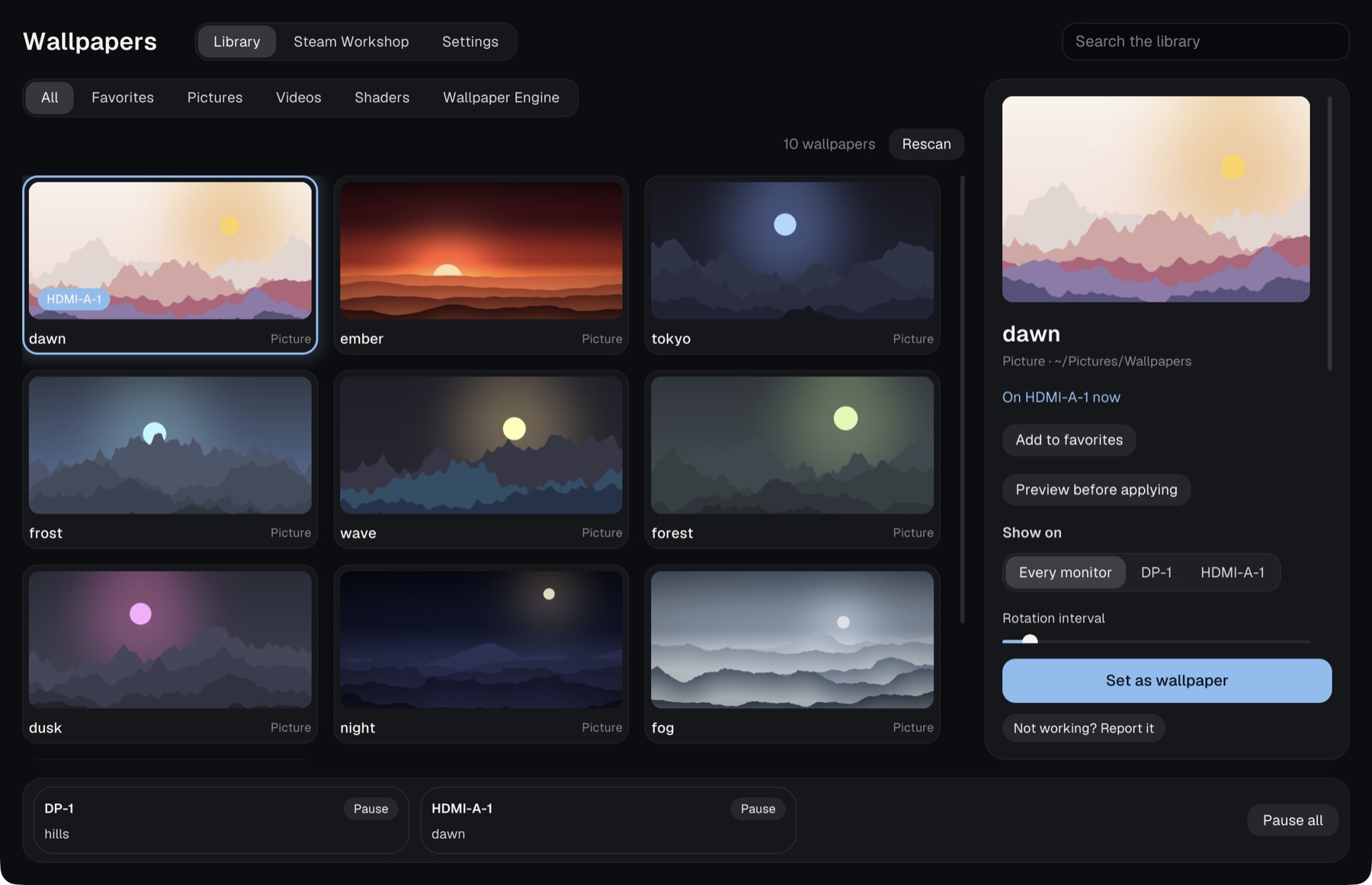
The Wallpapers app's library: pictures and a shader in a grid, dawn picked and shown large on the right, and along the bottom what each of two monitors plays
Library. Your folders and Wallpaper Engine's in one grid; pick a monitor or all of them, and see what each one plays along the bottom.
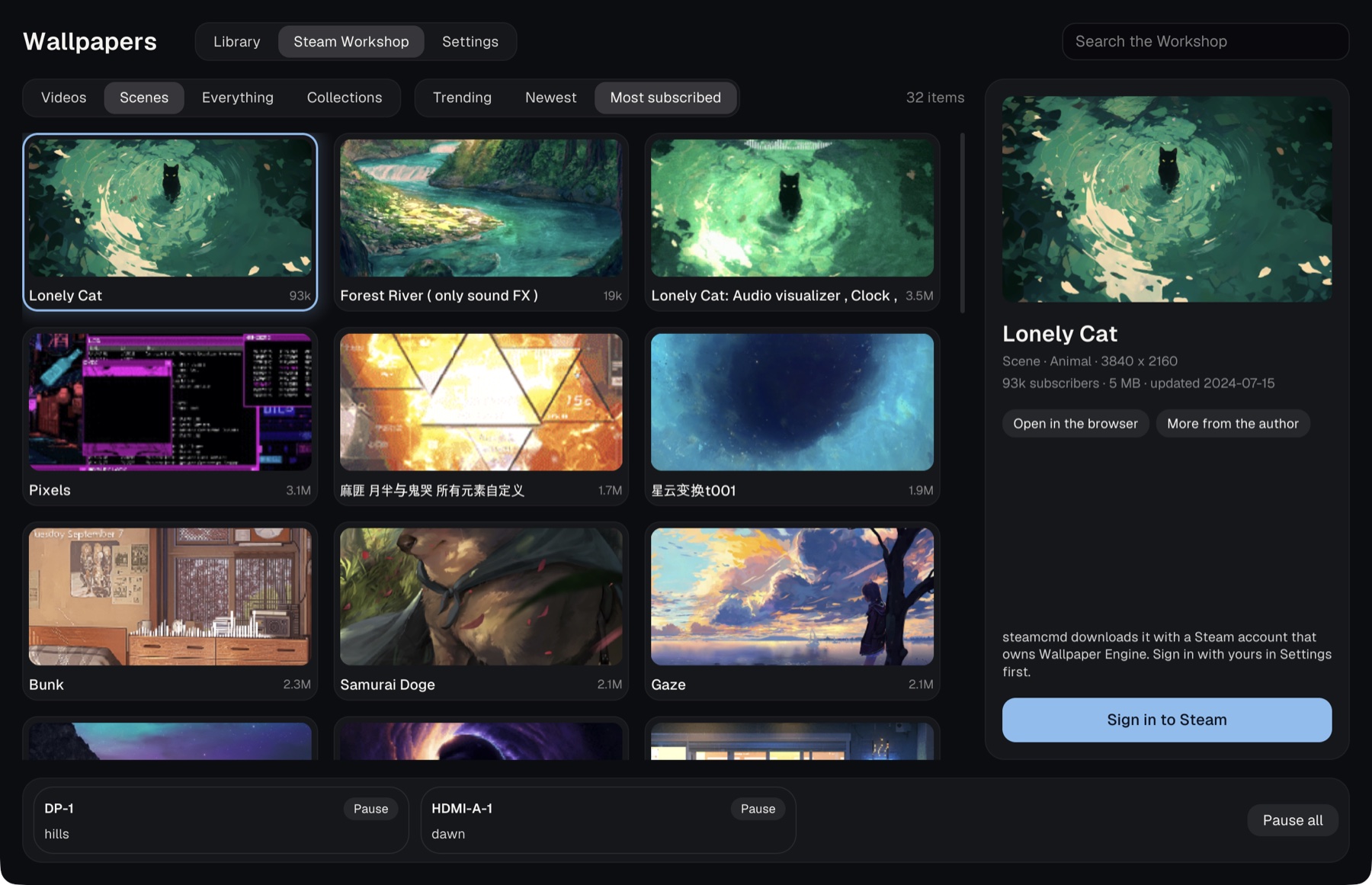
The Steam Workshop tab: the most subscribed scenes, with one opened on the right
Steam Workshop. Browsed without an account, by kind and by what's trending, new or most subscribed. The items are their authors'.

Library

Your wallpaper folders and everything Wallpaper Engine has on this machine, from every Steam library, native or Flatpak.

Steam Workshop

Browsed without an account. Subscribe in Steam, or download through steamcmd without the client.

Inspector

Every monitor or one; fill, whole, or whole with blurred edges; brightness, contrast, speed as a live draft.

Scene properties

The author's own checkboxes, sliders, colors and presets, and scenes that move to what's playing.

Rotation and tray

Rotate a filtered set or a folder every few minutes; pause, next and random from the tray.

Safe with anyone's files

Local files only for videos, size limits everywhere, scene scripts with no filesystem and no network.

Install

Arch first, a .deb for the rest.

On Arch, build the package:

git clone https://github.com/Pisosenie/apolline-wall && cd apolline-wall/packaging/arch && makepkg -si

Stop whatever draws your wallpaper now, start the daemon, and set something:

systemctl --user enable --now apolline-wall.service && apolline-wall set ~/Videos/rain.mp4

Debian 12 and Ubuntu 22.04 or newer: the .deb on each release. Under Apolline there's nothing to start: pick a live wallpaper in Settings → Appearance. The rest is in the docs.

What's new

apolline-wall 0.2.0

Every release
0.2.0
  • A folder as a playlist: apolline-wall playlist FOLDER --every SECONDS plays what a folder holds, read again before every step, so what's added joins and what's gone is skipped; the app offers to rotate a library folder from its inspector.
  • Scenes hear the music: audio-reactive Wallpaper Engine scenes get what's playing, through parec, in 64 bands a side.
  • KDE Plasma 6: a wallpaper plugin plays each monitor from a PipeWire stream under Plasma's icons and widgets, and monitors without it get the wallpaper on the bottom layer. The Debian package for Ubuntu 22.04 leaves the plugin out: its PipeWire is too old.
  • A paused monitor stops drawing a scene the others still show; a scene's canvas is only the part its monitors show, so a portrait monitor stays sharp; canvases shrink when a monitor leaves.
  • Project folders are read again only when they change; a poster that can't be saved falls back to the video file; steamcmd signs in from a private script, so the account name isn't on its command line.
  • X11: a click on the desktop no longer takes the focus, and under window managers without desktop windows, i3 for one, the wallpaper stays under every window instead of floating over them.
  • Built against apolline-scene 0.2.0: bigger scenes load, timelines on particle overrides play.
0.1.0

The first release: live wallpapers for Linux, and the wallpaper process of Apolline.

  • Pictures, videos and Shadertoy shaders on every monitor, each with its own wallpaper, fit (cover, contain, or blurred edges), look and playlist, crossfaded, on Wayland compositors with layer-shell and, untested yet, GNOME and X11.
  • Wallpaper Engine videos and scenes from your Workshop subscriptions, in every Steam library. Scenes are drawn natively by apolline-scene; what it can't draw yet, and web wallpapers, go to linux-wallpaperengine when it is installed.
  • One run for many monitors: a video decodes once and a scene runs once into a canvas of its own shape, whatever the number of monitors showing it.
  • Nothing spent while nothing shows: paused while locked, asleep or (optionally) on battery, and by the shell in game modes.
  • apolline-wallpapers, an app and tray to browse your library and the Workshop, set wallpapers per monitor, adjust their look and properties, and report a problem.
  • Safe with anyone's files: Workshop items are read with size limits and inside their folder, videos play local files only, scene scripts run sandboxed.
  • A CLI, a JSON-lines socket, and child mode for Apolline over stdin and stdout.